
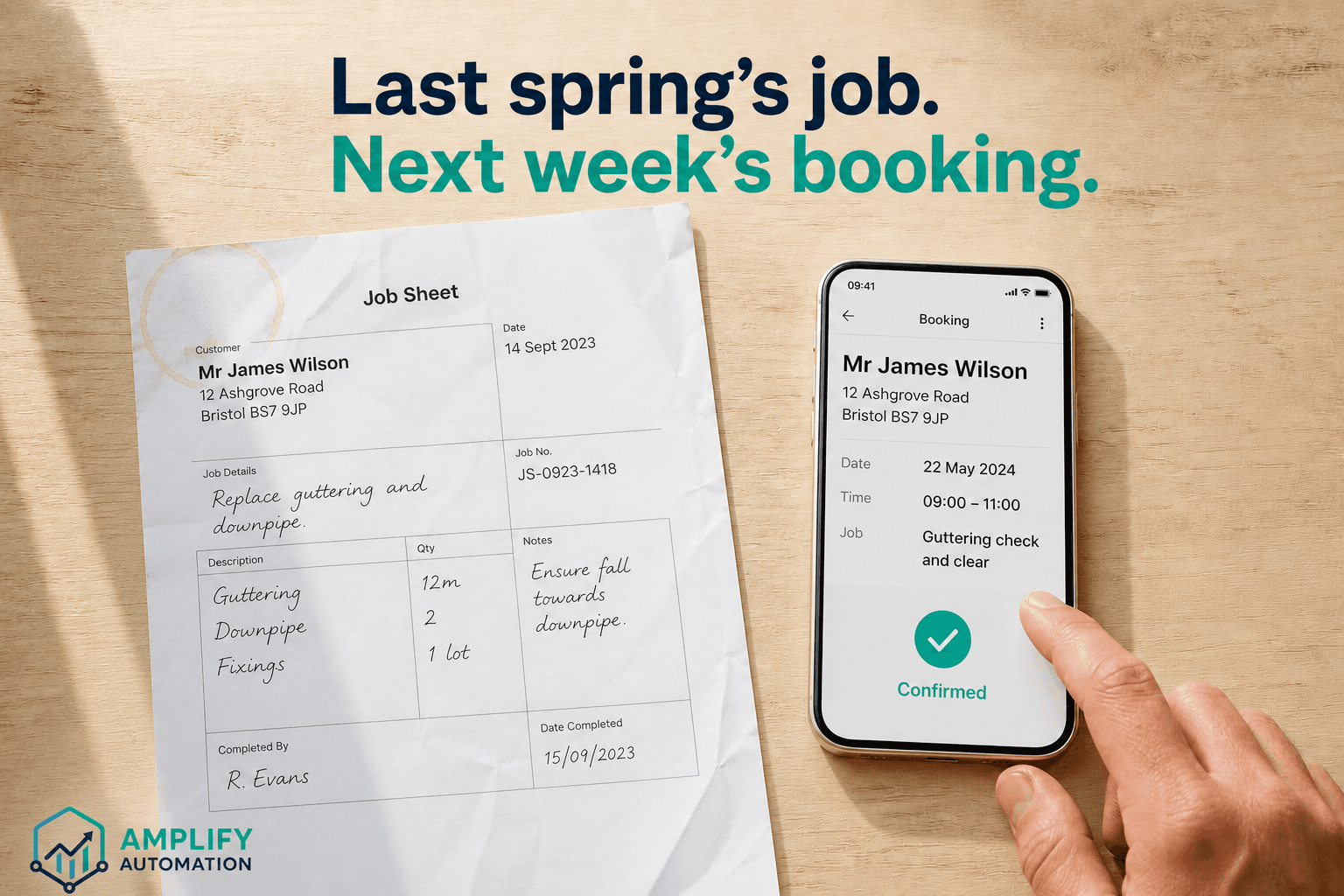
Somewhere in your system sits a list of people who have already paid you. They liked the work. They just have not called back.
That list is the cheapest pipeline you own, and most service businesses never touch it. Spring is about to arrive, the diary is about to fill, and the fastest way to fill it well is to ring the people who already trust you.
Reactivation is not lead generation
This is the bit worth getting straight before you do anything else.
Lead generation is convincing a stranger to take you seriously. It is slow, it is expensive, and you are competing on price with three other quotes. Reactivation is different. You are ringing someone who has your invoice in their filing cabinet. The trust is already built. You are not selling, you are reminding.
That changes the shape of the conversation. A reactivation call should run under a minute, give one clear reason to book, and make it easy to say no.
It also changes the economics. You're not buying clicks or paying a lead fee. You're calling a list you already own.
Why spring is the deadline, not the opportunity
Across most of Australia, the phone gets busier from September. Heating and cooling swaps over, outdoor work restarts, deferred maintenance gets approved, and property turnover picks up.
Here is the trap. Once you're flat out, you stop chasing anything. The old list stays untouched for another year, and you spend the busy season taking whatever comes through the door rather than choosing the work you actually want.
Running reactivation in the weeks before the rush means you head into spring with a diary you filled deliberately. It also smooths out the quiet patches, because you can control when the calls go out.
The three things that decide whether it works
When a reactivation campaign disappoints, it is almost always one of three things. Voice quality and timing are rarely the problem.
1. The list
Freshness beats volume. A contact who used you 12 months ago will remember you. Someone from four years ago probably will not.
As a rule of thumb, filter to customers from the last 18 months, scrub the duplicates, and clean up the phone number formats before anything else. A smaller, tighter list will beat a big messy one every time.
2. The offer
"Just checking in" doesn't book jobs. People need a concrete reason to say yes today.
Good reasons look like this: a seasonal service before the rush, a safety or compliance check that's due, a maintenance window about to expire, or a loyalty credit for past customers. Bad reasons are anything that sounds like a survey.
3. The script
Long, pitchy, generic scripts kill contact rates. The version that works is roughly 30 to 45 seconds: customer's first name, your business name, the reason for the call, the offer, and an easy out.
"Hi Sarah, it's Amplify calling on behalf of Riverside Facilities. You had us out last spring for the aircon service. We're booking this year's round now and wanted to see if you'd like a spot. Happy to take you off the list if you'd rather not hear from us."
That is the whole thing. Anything longer is you talking yourself out of a booking.
The maths, done honestly
These are the ranges we plan Amplify campaigns around. They are planning benchmarks, not promises, and your list quality moves them more than anything we do.
- Contact rate, the share of calls actually answered: 30% at the low end, 40% is a normal target, 50% is strong.
- Booking rate, the share of answered calls that turn into a booking: 8% at the low end, 12% is a normal target, 18% is strong.
Run that over a list of 1,000 past customers using the middle numbers. You reach roughly 400 people. Around 48 of them book something. If your average job is worth $600, that is about $28,800 of work out of a list that was sitting there doing nothing.
Change the assumptions and the answer changes. That is the point. Before you spend a dollar, plug in your own list size, your own average job value, and your own conversion, and see whether the campaign is worth running at all. If the numbers do not work, do not run it.
The rules you cannot skip
Calling past customers in Australia is legitimate, but there are conditions. Get these wrong and a good campaign becomes a compliance problem.
- The list must be people with an existing business relationship. Past customers, not a purchased or rented list.
- Offer an opt-out early in the call, not buried at the end.
- Apply the Do Not Call Register scrub before you launch, and honour your own suppression list.
- Call only within reasonable business hours in the customer's local time zone.
- If you are recording calls, say so at the start.
If you are using an AI voice agent and someone asks whether they are talking to a real person, the agent should say so plainly. Honesty here costs you nothing and protects the relationship you are trying to rebuild.
Where AI actually helps
You could do all of this manually. Plenty of businesses have someone on the phones for a week and get a solid result.
The reason most do not is capacity. Nobody has a spare week, and the calls get dropped the moment a real job comes in. An AI voice agent solves the capacity problem, not the strategy problem. It works through the list at a consistent pace, has the same short conversation every time, books straight into your calendar, and logs every outcome so you can see what worked.
What it won't do is fix a bad list or a weak offer. Those are still yours to get right. If you want to see how the pieces fit together, our Lead Reactivation page walks through the build.
Your checklist for this week
- Export your customer list and filter to the last 18 months.
- Remove duplicates, staff, suppliers, and anyone who has asked not to be contacted.
- Write down one concrete offer that gives people a reason to book before October.
- Work out your average job value, then do the maths above with your own numbers.
- Decide who is making the calls, and when. If the answer is "nobody has time", that is your signal to automate it.
- Set the window. Aim to have calls finished before the rush begins.
None of this is clever. It's just the work that never quite makes it to the top of the pile. Your competitors have the same list sitting in the same drawer, and most of them won't ring it either.