
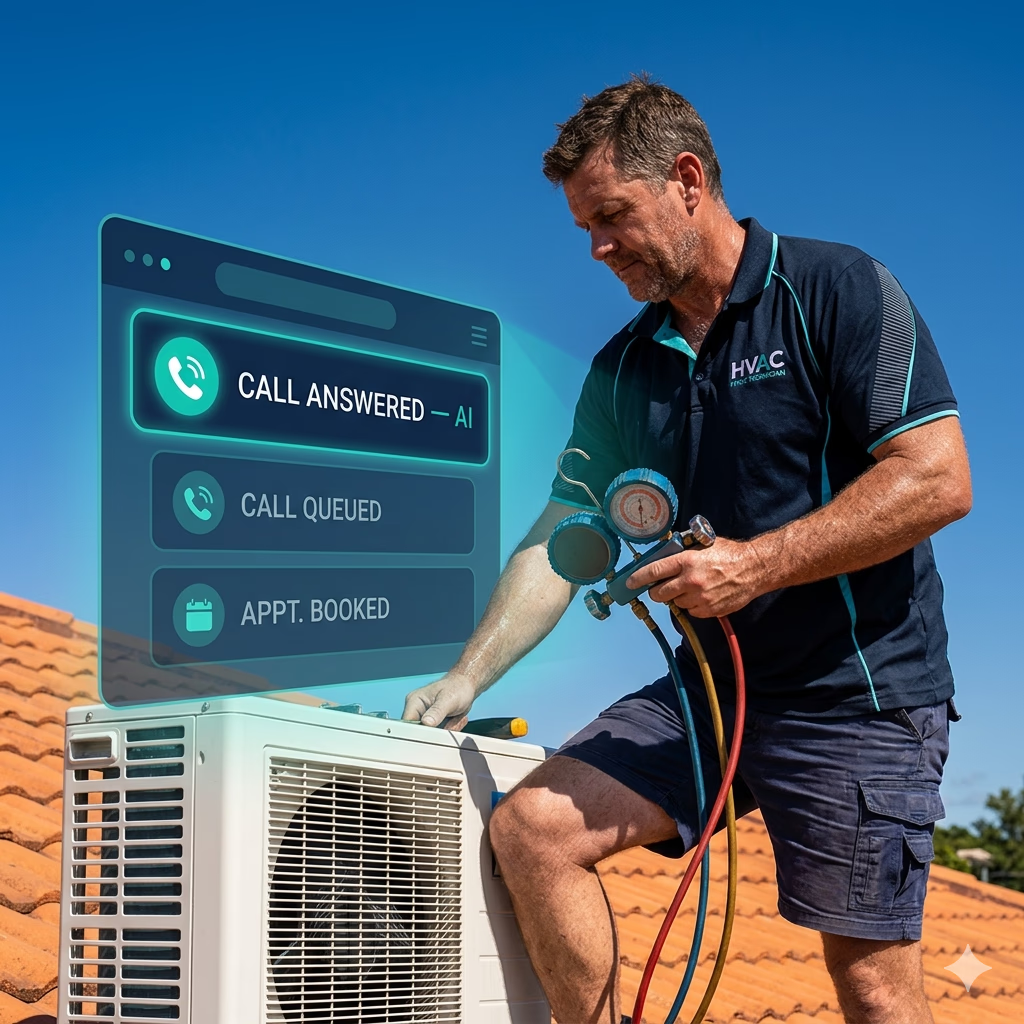
Every summer, Australian HVAC businesses face the same brutal problem: the phone rings off the hook, your techs are fully booked, and you're watching leads slip through the cracks because no one can answer fast enough. Voice AI for HVAC businesses is changing that, and the most forward-thinking aircon companies in Australia are already using it to handle the seasonal call surge without hiring extra staff.
If you run an HVAC or aircon business in Australia, this post will show you exactly how Voice AI handles the summer rush, what it does better than a human receptionist during peak periods, and how you can get set up before the next heatwave hits.
Why Summer Is a Make-or-Break Season for HVAC Businesses
Australia's summer heat is relentless. When temperatures push past 38°C in cities like Brisbane, Melbourne, and Perth, aircon units that have sat dormant all winter start to fail. Homeowners panic. They pick up the phone. They call the first business that answers.
That's the opportunity, and the trap.
If your phone goes to voicemail, they call the next business on the list. If you answer but can't book them in for days, they try someone else. And if your single receptionist is managing 40 incoming calls a day on top of scheduling and invoicing, quality drops fast.
Research from the Australian HVAC industry consistently shows that response speed is the number one factor in winning emergency service calls. Customers choose the business that gets back to them first, not necessarily the cheapest or the most experienced.
Voice AI solves the volume problem. It answers every call instantly, around the clock, without putting anyone on hold.
What Voice AI Actually Does During a Summer Surge
Think of Voice AI as a tireless phone operator who never takes a lunch break, never goes on leave, and can handle 10 calls at the same time.
When a homeowner calls your HVAC business during a summer heatwave, a Voice AI system can:
Answer immediately, every time. No hold music. No "we're currently experiencing high call volumes." The call is answered on the first ring, any time of day or night.
Qualify the job and capture details. The AI asks the right questions: Is this a breakdown or a new installation? What's the make and model of the unit? What suburb are you in? How urgent is it? All of that information is captured before a human even needs to get involved.
Book appointments directly into your scheduling system. Many Voice AI setups integrate directly with job management software like ServiceM8, Tradify, or simpler calendar tools. The customer picks a time, the job gets logged, and your tech gets a notification.
Triage emergency jobs. You can set rules so the AI escalates genuine emergencies, like a customer with a newborn in a 40-degree house, by flagging the job as urgent or routing the call to an on-call tech.
Handle after-hours enquiries. This is huge for HVAC businesses. A large proportion of breakdown calls come in the evening, when the homeowner finally gets home and realises the unit isn't cooling. Voice AI captures these leads and books them in for the next morning, so your first appointment of the day is already locked in before you start work.
A Summer Scenario: Two HVAC Businesses, One Heatwave
Imagine two similar aircon businesses in Brisbane. Both have three technicians on the road. Both cover the same suburbs. Both have comparable pricing.
Business A relies on one part-time receptionist who works 9am to 5pm. During the summer peak, she handles around 25 calls a day comfortably. When call volume spikes to 60 or 70 on a 38-degree day, calls start going to voicemail. Response to enquiries slows. Some leads don't get followed up until the next morning, by which time they've already booked with a competitor.
Business B set up Voice AI before summer. During that same heatwave day, every one of those 70 calls is answered immediately. The AI qualifies each job, books straightforward services directly into the calendar, and flags two genuine emergency situations for the owner to call back within the hour. By 9am the next morning, Business B's techs have a full day of jobs, including three that came in after 6pm the previous evening.
Business A lost at least a day's worth of billable work. Business B captured every opportunity that came its way.
Setting Up Voice AI for the Summer Season
You don't need to be a tech expert to implement Voice AI for your aircon business. Most modern Voice AI platforms are designed to be set up and configured in plain English, not code.
Here's how the process typically works for an HVAC business:
Step 1: Define what you want the AI to handle. Start simple. List the five most common types of calls you get during summer: breakdown bookings, new installation enquiries, service reminders, pricing questions, and after-hours emergencies. These become the AI's core scripts.
Step 2: Connect your booking system. If you use ServiceM8, Tradify, or even a Google Calendar, there are straightforward integrations that let the AI write directly into your schedule. No double handling.
Step 3: Set your escalation rules. Decide what the AI should handle autonomously and what it should pass to a human. Emergency calls with vulnerable people (elderly, infants, health conditions) should always trigger a human callback.
Step 4: Test before peak season. Run the system for a few weeks before summer. Use real call scenarios. Listen to recordings. Adjust the scripts so the AI sounds like your business, not a generic robot.
Step 5: Go live and monitor. Once you're confident, let it run. Review weekly call summaries to spot patterns, adjust common question responses, and keep improving.
The whole setup process for a typical HVAC business takes a couple of weeks from first conversation to go-live.
What About Customers Who Don't Like Talking to AI?
It's a fair concern. Some customers, particularly older Australians, prefer to speak with a real person. A well-designed Voice AI system accounts for this.
Good AI doesn't pretend to be human, but it also doesn't feel robotic. When it's configured correctly, it sounds natural, asks sensible questions, and moves the conversation forward efficiently. Most customers care far more about getting a fast, helpful response than about whether a human or a machine picked up the phone.
You can also configure the system to offer a callback option for customers who specifically request it. The AI captures their details and your team returns the call when capacity allows. Everyone gets served; no one gets ignored.
Implementation Checklist
- Audit your current call volume and identify peak hours and days
- List your five most common summer call types (breakdowns, quotes, servicing, etc.)
- Choose a Voice AI platform that integrates with your existing job management software
- Write simple scripts for each call type in plain language that sounds like your business
- Set escalation rules for genuine emergencies
- Connect your calendar or booking system and test with real scenarios
- Train your team on how the AI handover process works
- Go live at least four weeks before peak summer season hits
- Review weekly call data and refine responses based on what customers are actually asking
Ready to get ready for summer 2026? Book a free 30-minute discovery call to see how Voice AI can help your HVAC business capture every lead, handle the seasonal surge, and stop missing calls when it matters most.